Kobayashi
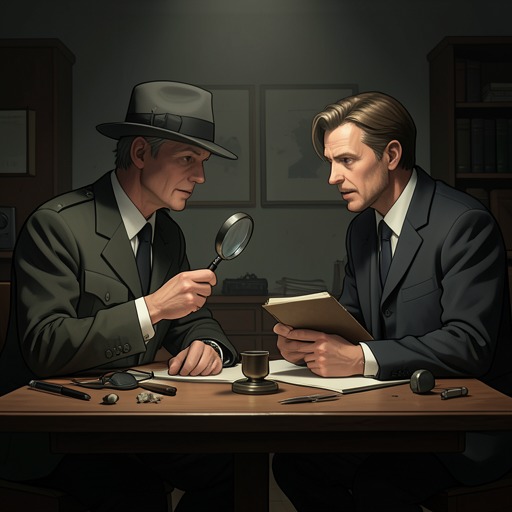
The Final CurtainKobayashi, identified as Squad Leader Kobayashi, is the senior investigator coordinating the inquiry into Michiko Oshitani’s murder. His role is practical and connective: he receives information, assigns detectives to follow it, and turns scattered leads into lines of investigation. As the evidence shifts from identifying the victim to tracing her connections and finally to locating a suspect, he keeps the case moving while distinguishing promising inferences from questions that remain unanswered.
Identity and Authority
Kobayashi is in charge of the case and introduces himself that way when Michiko’s brother, Fumihiko Oshitani, and sister-in-law, Masako Oshitani, come to the investigators. Facing the couple in a conference room with five investigators present, he thanks them for making the trip, identifies himself as the squad leader, and invites them to sit. He then asks whether they have identified Michiko’s effects. Fumihiko confirms that his wife recognized the watch, handbag, and travel pack as belonging to his sister. The exchange establishes Kobayashi’s formal authority and his role in handling the family’s participation in the investigation with direct, procedural questions.
That authority extends to assigning work. After the Oshitanis confirm the victim’s identity, Kobayashi and Unit Chief Ishigaki confer in the incident room and summon detectives for instructions. He gives Matsumiya and Sakagami Fumihiko’s business card and directs them to travel to Shiga Prefecture the following day. Their task is to visit the firm where Michiko worked and investigate her friends, relationships, and any links to Tokyo, reporting their findings immediately. Kobayashi offers to send backup if the detectives judge it necessary. The assignment turns the family’s confirmation into a broader inquiry into Michiko’s life and possible connections beyond the crime scene.
Directing an Expanding Investigation
Kobayashi remains involved as the investigation accumulates documentary and forensic material. In a small meeting room at the Tokyo Metropolitan Police headquarters, Sakagami works through forensic sketches based on interviews with people who had seen Mutsuo Koshikawa, while Kobayashi checks on progress. The task is uncertain: Sakagami says he has not yet found a likely match and questions how accurately the sketches represent Koshikawa. Kobayashi’s brief arrival places him within the work of testing imperfect leads rather than treating investigative tools as conclusive.
A later meeting shows him presenting a more definite result. He lays out enlarged photographs of handwritten ideograms, including characters and place names, and tells Kaga that experts have compared two pieces of handwriting: annotations on the calendar in Mutsuo Koshikawa’s apartment and a handwritten note Kaga supplied. The analysts conclude that the same person wrote both. This finding connects an object recovered in the murder investigation with a note from Kaga’s personal effects, giving the team a specific point of comparison. Kaga tenses at the news; Matsumiya, seated beside him, shares his excitement. Kobayashi delivers the result directly, putting its importance before the detectives without prematurely explaining what the connection means.
His manner changes with the state of the case. When Matsumiya returns from speaking with Emiko Okamoto and reports that she cannot identify Hiromi Asai’s boyfriend, Kobayashi responds in a brighter voice than usual. He accepts that the interview did not resolve the question, says the boyfriend may have nothing to do with the case, and commends Matsumiya for doing what he could. The exchange shows him allowing a lead to remain inconclusive rather than forcing it into the investigation’s central theory.
Following the Radiation Records Lead
The investigation’s focus sharpens when a timetable is brought into the incident room and attention turns to people who worked at the Onagawa nuclear power plant. Kobayashi drops the timetable onto the table with relief and announces that the unit is finally making progress, adding that the development will help the unit chief’s credibility. He orders a detective to prepare a plan for examining the plant’s workforce. The timetable thus becomes more than a clue: it prompts an operational response and signals a change in the team’s confidence.
The lead develops through Matsumiya’s report about Sadakichi Nozawa, whose account of manual labor at nuclear power stations describes workers as people consumed to keep the facilities running. After hearing Matsumiya’s findings, Kobayashi is the first to voice the possibility that Nozawa’s information identifies their man. Ishigaki agrees that Nozawa’s work for a firm called Watabe is difficult to dismiss as coincidence. Kobayashi then summons Otsuki, explains the substance of Matsumiya’s report, and orders him to search for subcontractors with “Watabe” in their company names. His response is methodical: a suggestive connection becomes a targeted records search, not yet a settled conclusion.
Ishigaki immediately articulates the remaining problem: even if Mutsuo Koshikawa, also known as Shunichi Watabe, was Kazutoshi Yokoyama, the team still has to determine why he was murdered. Kobayashi’s actions have helped identify a possible connection among a name, a contractor, and the victim’s identities, but the motive remains open. The distinction matters to his investigative role: he advances the inquiry without confusing the identification of a suspect with an explanation of the crime.
Hiromi Asai and the Limits of Procedure
Kobayashi’s attention later turns to Hiromi Asai’s movements. A telephone report reaches him while Matsumiya is nearby; after listening, Kobayashi tells Ishigaki that Hiromi is deviating from her regular routine. He suspects that Kaga may have prompted the change, given Kaga’s private acquaintance with her, and insists that this personal connection does not entitle Kaga to conduct the investigation as he pleases. He asks Matsumiya to call Kaga in and have him explain what is happening. When Matsumiya cannot reach Kaga because his phone appears to be switched off, Kobayashi reacts with irritation. The exchange places professional accountability against Kaga’s independent involvement, while making clear that Kobayashi’s suspicion about the cause of Hiromi’s changed routine is still a suspicion, not a demonstrated fact.
The investigation reaches Hiromi directly outside the theater. After she leaves the control room intending to use the curtain calls to go to the greenroom and congratulate the actors, she finds a group of men waiting for her. She recognizes Matsumiya but not the stern-looking man who steps forward, bows curtly, displays his Tokyo Metropolitan Police badge, and introduces himself as Squad Leader Kobayashi. He tells her that the police need to ask questions and asks her to accompany them to the station. Hiromi takes a deep breath. The encounter brings Kobayashi’s procedural authority into direct contact with the person the investigation has been trying to understand: a routine change that had prompted surveillance and suspicion now leads to a formal request for questioning.
Investigative Role
Kobayashi is characterized less through private history than through decisions made in the incident room and at moments when the investigation changes direction. He asks for identification of the victim’s belongings, sends detectives to Shiga to trace her relationships, circulates a handwriting comparison, redirects resources toward workers connected to Onagawa, and orders a search for Watabe subcontractors. His conduct repeatedly converts information into a next step while leaving unresolved questions visible: the uncertain accuracy of forensic sketches, the unknown identity of Hiromi’s boyfriend, and the still-unexplained reason for Yokoyama’s murder.
That balance between momentum and qualification shapes his function in the case. Kobayashi can sound relieved when evidence opens a promising path and impatient when Kaga cannot be reached, but he does not present every lead as proof. His final appearance before Hiromi makes the investigation’s accumulated pressure tangible: the squad leader who has directed the search now stands at the theater door, badge in hand, asking her to come to the station. The movement from files, timetables, and names to a face-to-face interview marks the point at which his administrative work becomes direct confrontation with a person central to the inquiry.